
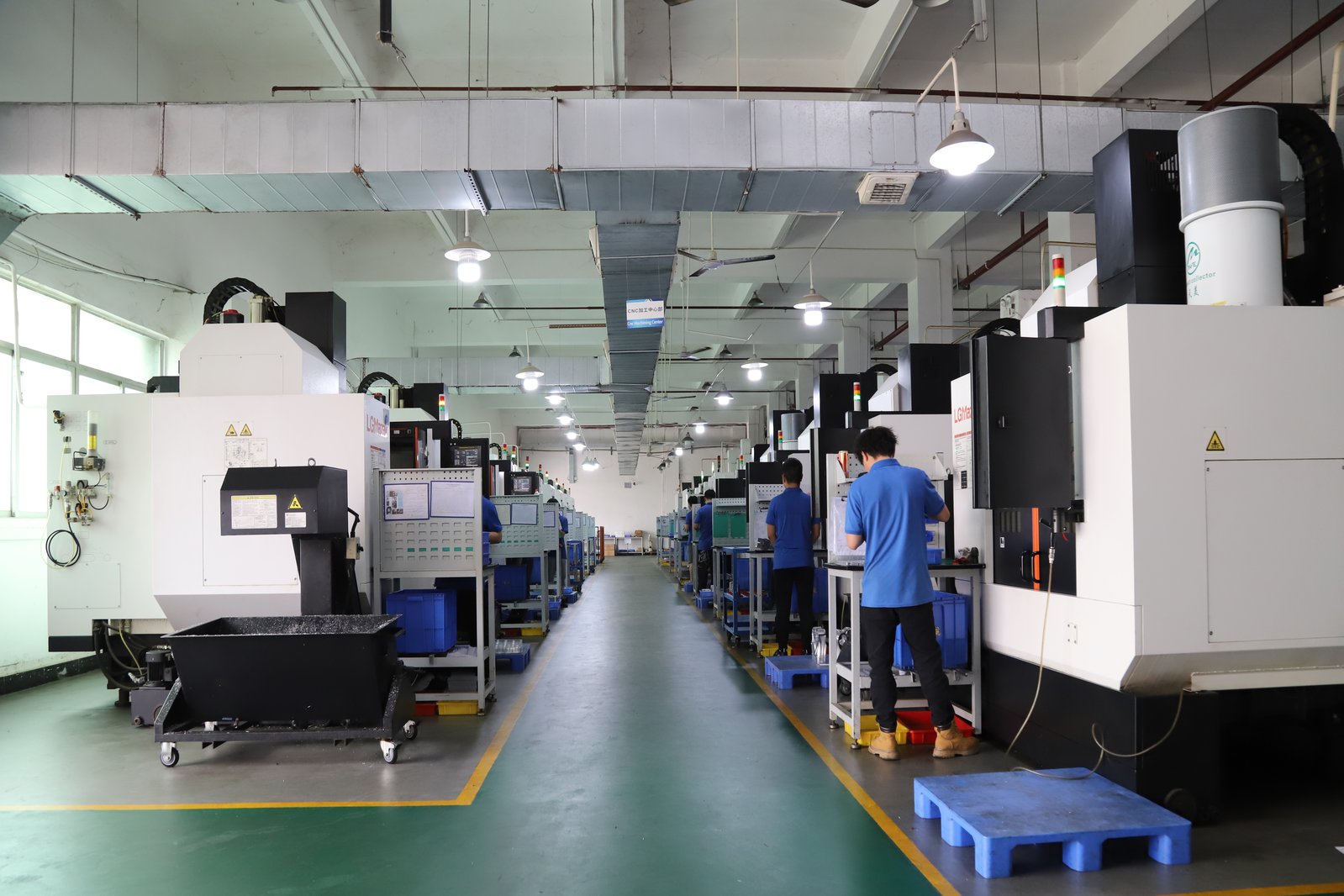
Every China metal-parts quote is a manufacturing plan with prices attached, and the plan is readable if you know the lines. Material, machine time, setups, finishing, inspection, and freight each carry part of the total, and each can be checked against your drawing. In 2026 the structure of those lines is stable enough that a buyer can compare two quotes on the same drawing instead of on the same sales page - and can tell which supplier is actually cheaper when the freight and the failure cost are added in.
The number to manage is not the unit price. It is the total cost of ownership: the price, plus freight and duty, plus the inspection you will do, plus the rework and delay cost when a batch drifts, plus the field cost when a part fails in service. The supplier with the lower unit price loses that comparison whenever its rejects, delays, or documentation gaps cost you more than the price difference. This guide shows how the lines are built, where the money goes, and how to run the comparison that picks the real winner.
1. What is a China metal-parts quote actually paying for?
A quote is a sequence of decisions priced one by one. The person who built it read your drawing, chose a material grade and stock form, decided how the part would be held and cut, counted the setups, named the finishing, and estimated the inspection. Every one of those decisions carries a line, and the total is the sum of the lines - not a number pulled from the air.
The lines repeat across honest suppliers. Raw material at the bought size. Setup and programming, paid once per order. Machine time, set by the material, the geometry, and the feature count. Secondary operations for features the primary process cannot reach. Finishing such as anodizing, plating, or heat treatment. Inspection and the documentation that proves the critical dimensions. And the commercial lines - packaging, freight under the agreed Incoterm, and the cost of the payment terms.
Two quotes on the same drawing differ because the plans differ: one supplier sees one setup where another sees two, one reads a tolerance as functional where another treats it as cosmetic, one includes finishing where another quotes it as an option. Read the quote as the plan and the differences become visible and negotiable. Read it as a number and you are comparing two different products by accident.
2. How does material set the floor under the price?
Material moves a quote twice: once as stock and again as machinability. A part machined from a plate or bar is priced from the stock actually bought - including the material machined away - so utilization is a real cost line. Then the same alloy decides how fast it can be cut, and cutting speed decides the cycle time. Aluminum is the cheap baseline on both counts; brass costs more per kilogram but machines so well it can win on total cost; stainless sits higher on both axes; titanium and the nickel alloys sit at the top of the range.
The grade on the drawing sets the comparison. "Aluminum" invites one supplier to price 6061 and another to price 7075, and the two quotes are not comparable. Name the grade and the condition - 6061-T6, 7075-T6, 304, 316L, 17-4PH, Ti-6Al-4V - and the suppliers are pricing the same metal. Confirm the stock form and size the quote assumes, because a larger starting plate or a non-standard bar diameter adds material and removal time that a standard size avoids.
Buyers who want the material line low do three things. They name the grade precisely. They design around standard stock sizes where the function allows. And they ask whether a near-net form - a tube instead of solid bar, a plate thickness closer to the finished part - can replace the blank the drawing implicitly assumes. Material is the one line that can be lowered before a single chip is cut.
3. What makes machine time - and with it the price - climb?
Machine time is where most of the real cost lives, and it climbs with the number of operations the part needs. A part that fits one setup on one machine is the economical baseline. Every feature that needs a second setup, a second machine, or a second process adds handling, fixturing, and datum risk, and each adds minutes that multiply across the quantity.
Geometry decides the operation count. Deep pockets and thin walls force light passes and slow feeds. Tight internal corners need smaller tools. Long slender features deflect and must be cut carefully. Features on multiple faces need indexing or extra setups. Each of these is a design decision that shows up in the quote as cycle time, and each can be revised on the drawing before the quote is requested.
Process selection matters as much as the geometry. A feature that needs grinding is a different process family with its own setup and queue; a thread that could be rolled instead of cut, a hole that could be drilled instead of bored - each alternative changes the time. The buyer's lever is to ask for the process route in the quote and question every step. A route you can see is a route you can shorten; a route that is hidden in the total is a route you are paying for without knowing it.
4. When does the drawing itself inflate the quote?
Drawings inflate quotes in three predictable ways, and all three are visible before you ask for the price. The first is tolerance density. A drawing that holds every dimension to a precision band - milling and turning at ±0.003 mm, grinding at ±0.002 mm, with capability targets such as Ppk ≥ 1.67 at the initial study on key characteristics and Cpk ≥ 1.33 on general characteristics. Capability is reported per characteristic: every report names the feature, its tolerance band, the sample size, the sigma method, and the study window. - converts a routine job into an inspection project, because every controlled feature must be measured and documented. The bands are real and achievable; the point is that they cost cycle time and inspection, and they should sit only where the assembly needs them.
The second is secondary geometry. Features that the primary process cannot reach in its normal setup - cross holes at angles, undercuts, milled slots on a turned part, deep narrow pockets - each pull the part into another operation with its own setup and hand-off. The third is ambiguity. A drawing with no material grade, no finish, and no statement of which features are critical forces the supplier to price the uncertainty, and the price of uncertainty is margin.
The fix for all three is on the drawing. Concentrate the tight callouts where they function, question every feature that needs a second process, and complete the specification so the shop can quote what you need instead of what it fears you mean. A drawing that does this reliably quotes lower than the same part released sloppy - every time.
5. What do setups, tooling, and quantity do to the unit price?
Setup, programming, and first-article inspection are fixed costs paid once per order, and quantity is the denominator that spreads them. A one-piece prototype carries the entire fixed cost on that single part, which is why it looks expensive. At fifty pieces the same fixed cost is nearly invisible; at five hundred it is noise. The unit-price curve on machined parts is mostly the amortization of fixed costs, and it flattens once material and machine time dominate.
Tooling behaves like a fixed cost with a shorter life. Standard tools are shared across jobs and their cost is spread through the machine-hour rate. A special form tool, a profile cutter, or a dedicated fixture for your geometry is a line that someone pays once - either as an explicit tooling charge or hidden in a higher unit price. Ask which is the case, because an explicit tooling line is usually the cheaper and more honest arrangement.
Quantity also changes the process economics. A complex part at low volume is often cheaper on a multi-axis machine that holds it in one setup, while at high volume the setup cost matters less and the cheaper machine hour can win back the work. Quote the quantity you actually plan to order and ask the shop to name the route at that quantity, because the answer changes with the volume.
6. Where do finishing and inspection sit in the stack?
Finished parts rarely ship bare, and finishing is where quotes diverge. Anodizing, plating, passivation, powder coating, and heat treatment each add a process with batch economics, and each behaves differently with quantity. Clear anodize on a batch of parts is a modest per-piece line; hard anodize with thickness verification costs more; plating may travel to an outside specialist whose batch calendar and margin land on your price.
Inspection follows the tolerance content. A part with general tolerances is verified with routine instruments. A part with controlled features earns CMM time, and on a governed program the CMM report ships with the parts. Material certificates, where required, are part of the documentation line. None of this is free, and none of it is optional once the drawing or the contract demands it - which is why a quote that stops at the machined surface is incomplete, not cheaper.
Confirm what the quote includes before comparing. "Anodized" can mean clear, dyed, or hard; "inspected" can mean a spot check or full dimensional documentation. Line the offers up by finishing specification and inspection deliverable, and the price differences that remain are real differences rather than scope artifacts.
7. Why is total cost of ownership the number that decides?
The unit price is the visible number; the total cost of ownership is the number that decides whether the sourcing decision was good. TCO adds the freight and duty, the inspection you will do at receipt, the inventory you must carry across the transit time, the rework and scrap when a batch drifts, the delay cost when a delivery slips, and the field cost when a part fails in service. On sourced parts from China, the gap between unit price and TCO is wider than buyers expect, because freight, transit time, and quality risk all scale with distance.
That is why the comparison that matters is a model, not a spreadsheet of unit prices. For each supplier, add the freight under the agreed Incoterm and any duty. Add an expected defect rate multiplied by the cost of handling one defect. Add the inventory cost of the longer transit. When the math is done, the supplier with the higher unit price and near-zero rejects usually wins - and the supplier with the lower unit price and a history of documentation gaps loses by more than the price difference.
Buyers who run this model make the sourcing decision on evidence. Buyers who compare unit prices are comparing the visible tip of a cost iceberg, and the part of the iceberg they cannot see is where the expensive surprises live. The TCO model is the difference between a decision that looks right in the purchase order and one that is right in the annual review.
8. How do you compare quotes and build a 2026 budget that holds?
Compare quotes as process plans, not as totals. Normalize every offer on the same material grade and stock form, the same process route and setup count, the same finishing, the same inspection documentation, and the same Incoterm. Ask each supplier to state the route and the setup count the price assumes, because those two numbers make the differences between quotes visible and negotiable.
Then read the technical feedback. A supplier that flags a tolerance that is tighter than the function needs, proposes a cheaper geometry, or questions the material choice is engineering your cost down. A quote with no questions at all usually means the drawing was priced with a wide safety margin, and you are carrying that margin.
Build the budget in three steps. Fix the specification first - grade, tolerances, finishing, documentation - so every supplier prices the same part. Quote the prototype and the production tier on the same page so the amortization is visible. Then run the TCO model on the survivors and choose on total delivered cost at your real quantity. A budget built that way holds across reorders and design changes, because it is built on the process and the economics, not on the lowest number in the inbox.
Frequently Asked Questions
What does a machined metal part from China cost in 2026?
No honest number exists without a drawing, because material, geometry, tolerance, and quantity move the price more than any average. As planning bands at small quantity, a simple 6061 bracket or turned pin commonly sits in single digits to the low tens of USD per piece, while complex multi-process parts in stainless or titanium climb well beyond that. Treat the bands as sanity checks, never as quotes.
Why do two suppliers quote the same part very differently?
Almost always because the scope differs. Compare the material grade, the process route and setup count, the tolerance interpretation, whether finishing is included, the inspection documentation, and the Incoterm. A quote built on a simpler route or a cheaper material than your drawing describes is not a better price - it is a different product.
Is machining from China still cheaper after freight and duty?
Often yes for labor-intensive work - complex fixturing, long cycle times, secondary operations - because the labor content is where the saving sits. But freight, duty, and the cost of carrying inventory in transit eat part of the gap, and at low quantities the advantage shrinks. Model total landed cost at your quantity instead of assuming the saving is automatic.
How much of a quote is the raw material?
Material is priced from the stock actually bought, not the finished part weight, so utilization matters. On a small part the material line may be a few percent of the total; on a large plate housing or a titanium part it can dominate. Naming the exact grade and starting from standard stock sizes keeps the line low and comparable.
What does a tight tolerance add to the price?
It adds process steps and inspection. Precision milling and turning hold ±0.003 mm and grinding reaches ±0.002 mm, with capability targets such as Ppk ≥ 1.67 at the initial study on key characteristics and Cpk ≥ 1.33 on general characteristics. Capability is reported per characteristic: every report names the feature, its tolerance band, the sample size, the sigma method, and the study window., and each controlled feature earns measurement time. When every dimension on the print is tight, the part pays for inspection the assembly never needed.
Do bigger quantities always lower the unit price?
Up to the point where fixed costs are fully spread. Setup, programming, and first-article inspection divide across the run, so the unit price falls as quantity rises and then flattens once material and machine time dominate. Ordering beyond real demand lowers the price on paper but raises inventory cost and obsolescence risk.
What costs hide outside the quoted unit price?
Tooling and fixtures, engineering changes, finishing quoted as an option, extra inspection documentation, freight under the agreed Incoterm, and the cost of the payment terms. A unit price is meaningless until those lines are stated, which is why an itemized quote is the only comparable one.
What is the fastest way to lower a China metal-parts quote?
Remove the ambiguity the supplier has to price around. Name the material grade and condition, tolerance only the functional features, keep the geometry to standard tooling, and specify the finishing and inspection in the RFQ. A complete drawing is a discount; an incomplete one is a tax.
Want an itemized number for your part?
Send the drawing to [email protected] with material, quantity, and finishing, and ask for the route, itemized price, and inspection plan in one reply.